
Here you have the same Benchy. They look similar, but one is printed using FDM, the other using SLA. The difference is visible under a magnifying glass.
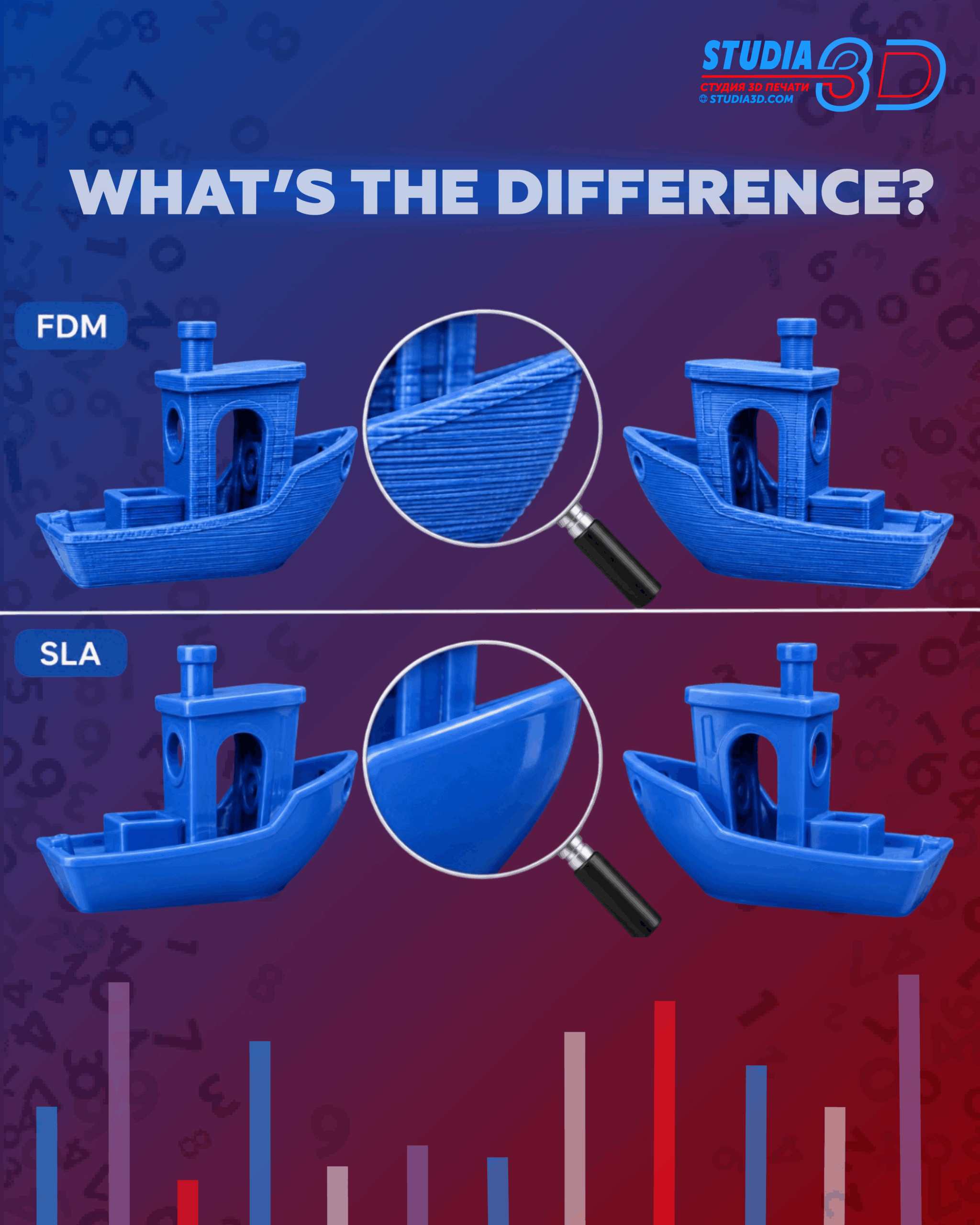
FDM: the plastic filament melts and is laid down layer by layer. The surface retains the nozzle marks — horizontal lines and layering, which are noticeable even without a magnifying glass. The technology is affordable, durable, and suitable for large objects, but the smoothness and micro‑details require manual sanding and priming.
SLA: the laser illuminates the liquid photopolymer, layer by layer. There are no filaments or nozzles: the shape is formed in the bath and emerges as a solid object with a smooth, glossy surface. Under a magnifying glass — not a single line, only pure geometry. Accuracy to the tenth of a millimeter; suitable for jewelry models, complex relief, and objects where every detail matters.
If you need a functional part, a large case, or a budget prototype — choose FDM. If you need jewelry‑level precision, a smooth surface, or a model for casting — choose SLA. At “Studia3D,” we work with both technologies and select the best one for a specific task.
More cases created using FDM and SLA 3D printing are available here.
Studia3D — we bring your boldest ideas to life.
Email: 3Dprint@studia3D.com.







Автор: PR service Studia3D
Другие статьи от PR service Studia3D